
Some Articles Published by our Faculty
This page lists some of the shorter articles that have been published by our faculty about their research. Note that some of these articles have student co-authors, reflecting the department's commitment to undergraduate research.
 |
"A revision and extension of results on 4-regular, 4-connected, claw-free graphs." Erika King, Trevor Gionet, and Yixiao Sha, Discrete Applied Mathematics, July 2011Trevor Gionet (Hobart College '12) and Yixiao Sha (William Smith College '12) worked on a summer research project in 2010 with Professor Erika King. The goal of the project was to find a more efficient way of proving a theorem characterizing 4-regular, claw-free, well-dominated graphs. However, during their first week of research, Yixiao and Trevor discovered a graph that was omitted from a characterization by Michael D. Plummer originally used to prove the theorem. Thus their research was redirected to revise Plummer's characterization. They were able to complete Plummer's characterization and revise a result in a paper that used that characterization. |
 |
"VIREOS: An Integrated, Bottom-Up, Educational Operating Systems Project with FPGA Support." Marc Corliss and Marcela Melara, SIGCSE Technical Symposium on Computer Science Education, March 2011. (PDF)In this paper, Professor Marc Corliss and Marcela Melara (William Smith College '12), discuss VIREOS, a simple, UNIX-like operating system developed by Professor Corliss for use in courses on operating systesm. In her summer research project, Marcela Melara worked on the implementation of VIREOS on FPGAs (field programmable gate arrays). |
 |
"Dominating sets in plane triangulations." Erika L.C. King and Michael J. Pelsmajer. Discrete Mathematics, June 2010.This paper by Professor Erika King and Michael Pelsmajer (Illinois Institute of Technology) proves a result about dominating sets in graphs of at degree at most six. A dominating set in a graph is a set of vertices such that every vertex is either in the set or is connected by an edge to a vertex in the set. |
 |
"Bantam Java Compiler Project: Experiences and Extensions." Marc Corliss, David Furcy, Joshua Davis, and Lori Pietraszek, Journal of Computing Sciences in Colleges, April 2010. (PDF)In this paper, Professor Marc Corliss, David Furcy (University of Wisconsin Oshkosh), Joshua Davis (Hobart '10), and Lori Pietraszek (William Smith '09) discuss experiences in teaching a compiler course using the Bantam Java compiler project, which enables students to write a Java-like compiler. The paper describes several significant extensions, including an extended source language, a Java Virtual Machine target, an Ant-based build process, and optimization and interpreter assignments. |
 |
"Larc: A Little Architecture for the Classroom." Mark Corliss and Robert Hendry, Journal of Computing Sciences in Colleges, April 2009. (PDF)This paper introduces the classroom architecture Larc, which was designed specifically for use in an introductory course on computer architecture. It includes work done by Rob Hendry as part of a summer research project with Professor Corliss. |
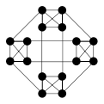 |
"Vertex-Magic Edge Labeling Games on Graphs with Cycles." Adam Giambrone and Erika King. Accepted for publication in the Journal of Combinatorial Mathematics and Combinatorial ComputingThis paper grew out of work done by Adam Giambrone (Hobart '08) as part of an Honors project that he did, with Professor King as his advisor. A vertex- magic edge labeling of a graph G is a one-to-one mapping from the set of edges onto the set {1,2,...,E} with the property that at any vertex the sum of the labels of all the edges incident to that vertex is the same constant. This paper proves some results about winning strategies in a game based on such labelings. |
"Quantitative Analysis by the Point-Centered Quarter Method." Kevin Mitchell, June 2007, published on arxiv.org. (PDF)This document is an introduction to the use of the point-centered quarter method, a technique used to study forest structure parameters such as population density and biomass. It briefly outlines its history, its methodology, and some of the practical issues and modifications that inevitably arise with its use in the field. Additionally this paper shows how data collected using point-centered quarter method sampling may be used to determine importance values of different species of trees and describes and derives several methods of estimating plant density and corresponding confidence intervals. |
|
"Latently infected cell activation: A way to reduce the size of HIV reservoirs?" Jonathan Forde, Joseph M. Volpe, and Stanca M. Ciupe. Bulletin of Mathematical Biology, Vol. 74, No. 7 (2012)While antiretroviral drugs can drive HIV to undetectably low levels in the blood, eradication is hindered by the persistence of long-lived, latently infected memory CD4 T cells. Immune activation therapy aims to eliminate this latent reservoir by reactivating these memory cells, exposing them to removal by the immune system and the cytotoxic effects of active infection. In this paper, we develop a mathematical model that investigates the use of immune activation strategies while limiting virus and latent class rebound. Our model considers infection of two memory classes, central and transitional CD4 T cells and the role that general immune activation therapy has on their elimination. Further, we incorporate ways to control viral rebound by blocking activated cell proliferation through anti proliferation therapy. Using the model, we provide insight into the control of latent infection and subsequently into the long term control of HIV infection. |
|
"Dynamics of hepatitis B virus infection: what causes viral clearance?" STANCA M. CIUPE, ANNE J. CATLLA, JONATHAN FORDE, and DAVID G. SCHAEFFER. Mathematical Population Studies, Special Issue on Immunology of Infectious Disease, 18:87–105, April, 2011The virus Hepatitis B infects liver cells, leading to either acute or chronic liver disease. Immune responses involve both curing and killing of cells. Stability analyses show that viral clearance depends only on the strength of the combined killing and curing, independent of the characteristics of the cured cells. |
|
"A model of Varicella-Zoster reactivation" Jonathan Forde and Bailey Meeker, WS '09. Mathematical Biosciences and Engineering, 7:765–777, Oct, 2010Mathematical models have been used to study the dynamic interaction of many infectious diseases with the host's immune system. In this paper, we study Varicella Zoster Virus, which is responsible for chicken pox (varicella), and after a long period of latency, herpes zoster (shingles). After developing the model and demonstrating that is exhibits the type of periodic behavior necessary for long term latency and reactivation, we examine the implications of the model for vaccine booster programs aimed at preventing herpes zoster. |